Why End Grain Cutting Boards Outperform the Rest
Let’s take a moment to talk about something that doesn’t get nearly enough attention in the kitchen: the surface that takes the most abuse.
Your cutting board.
Our girl is about performance. An (ideally) well oiled workhorse that has hosted everything from heirloom tomatoes to a full blown 10:45PM emotional support charcuterie moment.
When it comes to performance, end grain unequivocally dominates the room. Not because its trendy, not because they photograph well (though… they absolutely do), but because structurally, mechanically, and biologically — they outperform the rest.
There is a science behind it…. And yes, I am about to be insufferably nerdy about it.
*Claps hands together* OKAY!
First: Woodology 101
I would hope that most of us already know that wood is organic matter, which means it literally used to be alive. It’s a carbon-based composite made of cellulose fibers (long, strong structural bands) held together by something called lignin (the built-in glue). Picture something like microscopic tube-like cells — bundles of drinking straws — that once carried water from roots to leaves. When the tree is cut and dried, those tubes remain and are permanently frozen in place. That cellular structure is why wood can absorb moisture, expand and contract with humidity, and ALSO — in the case of end grain — can actually pull bacteria down below the surface where it dries out and struggles to survive (forking COOL, right?!?)
Lesson two: The three common cutting board constructions
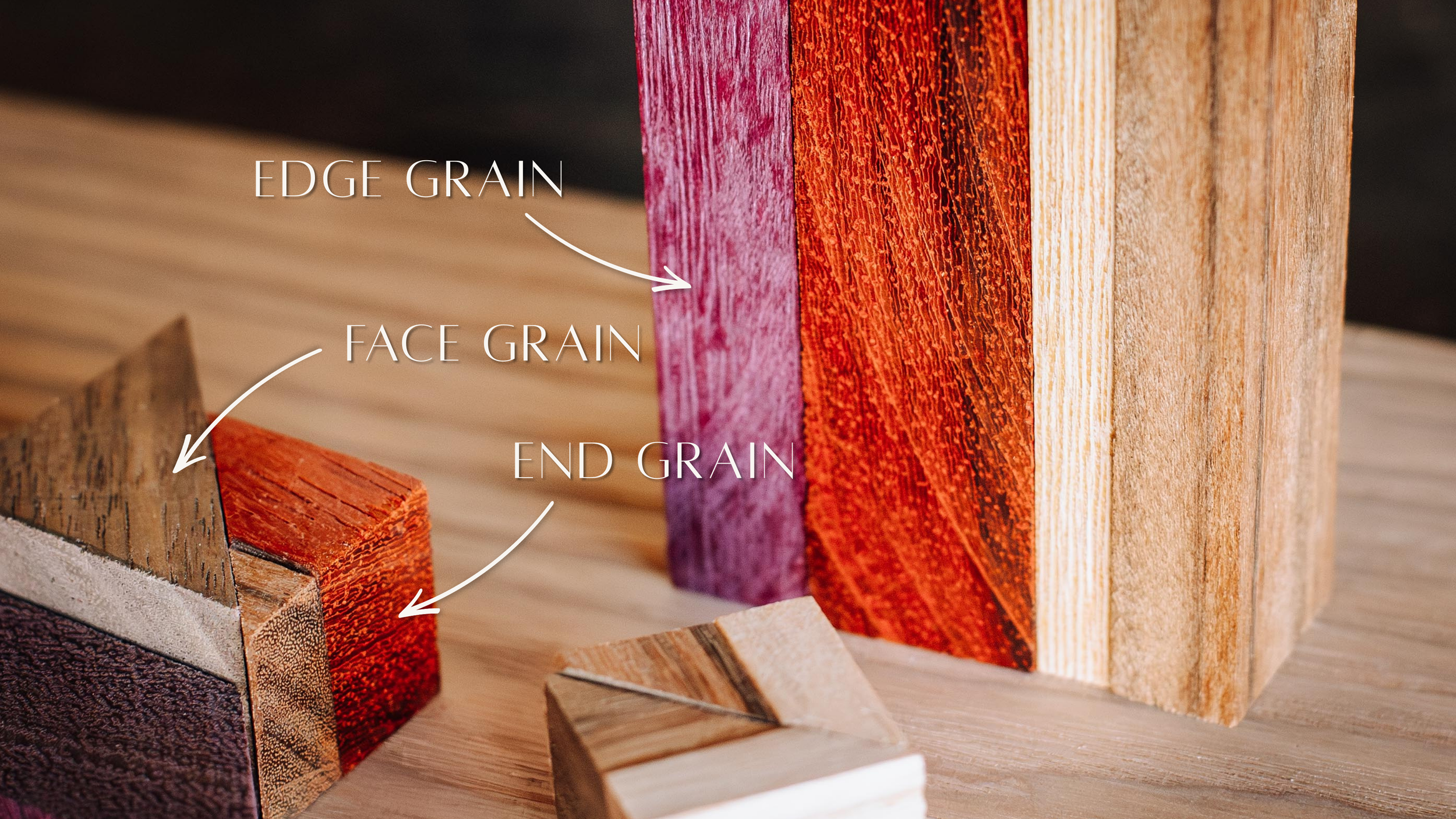
1. Face Grain (Flat Grain)
Beautiful. Dramatic. Cathedral grain patterns.
Mechanically speaking, though, when you cut on face grain, your knife slices directly across the long cellulose fibers. That can create visible knife marks and lead to long-term surface wear.
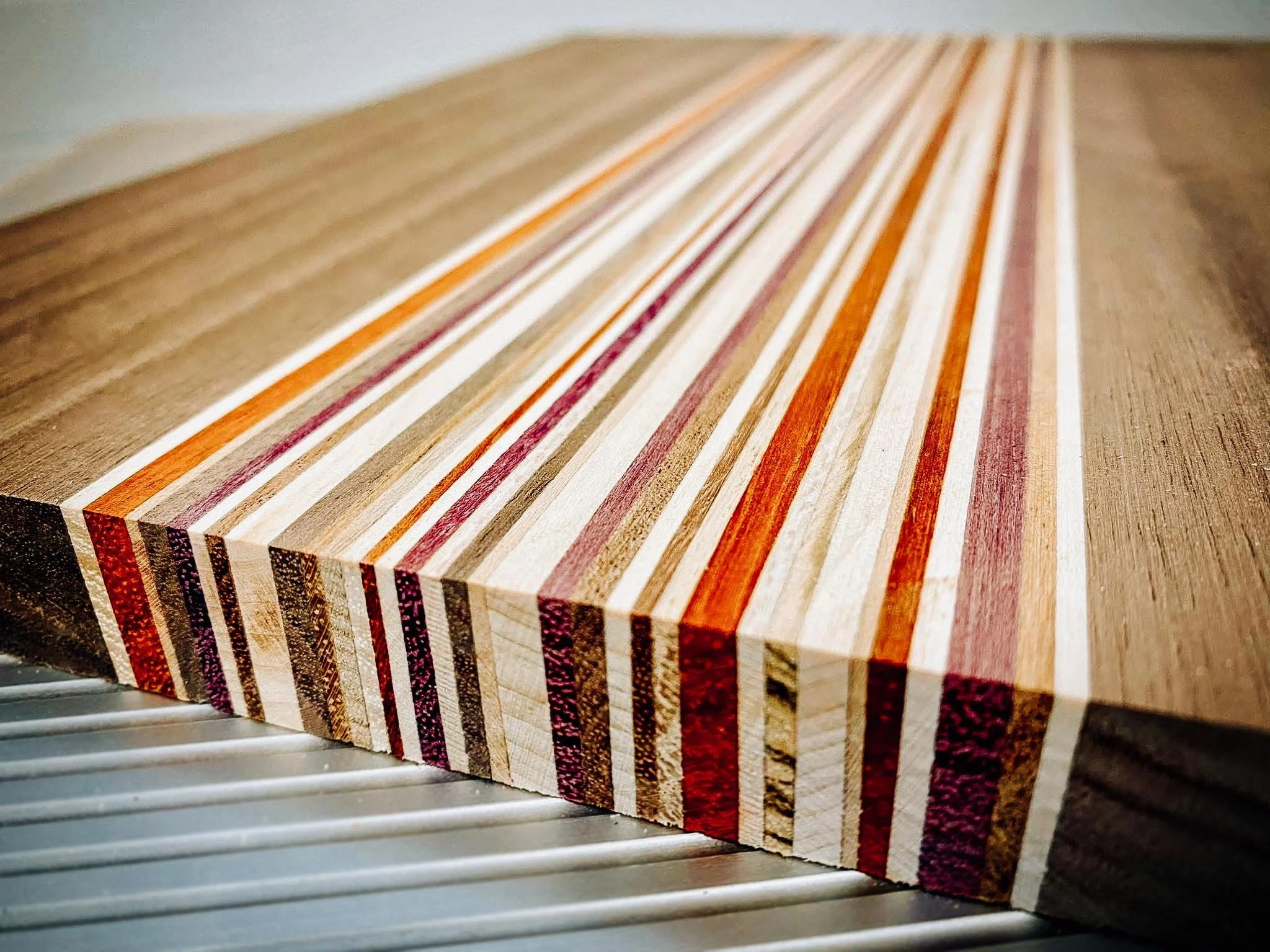
2. Edge Grain
More stable. Linear. Stronger than face grain.
Edge grain boards are created by ripping milled lumber into strips and gluing the long edges together. This orients the grain vertically relative to the surface, but you’re still cutting across fiber direction.
3. End Grain
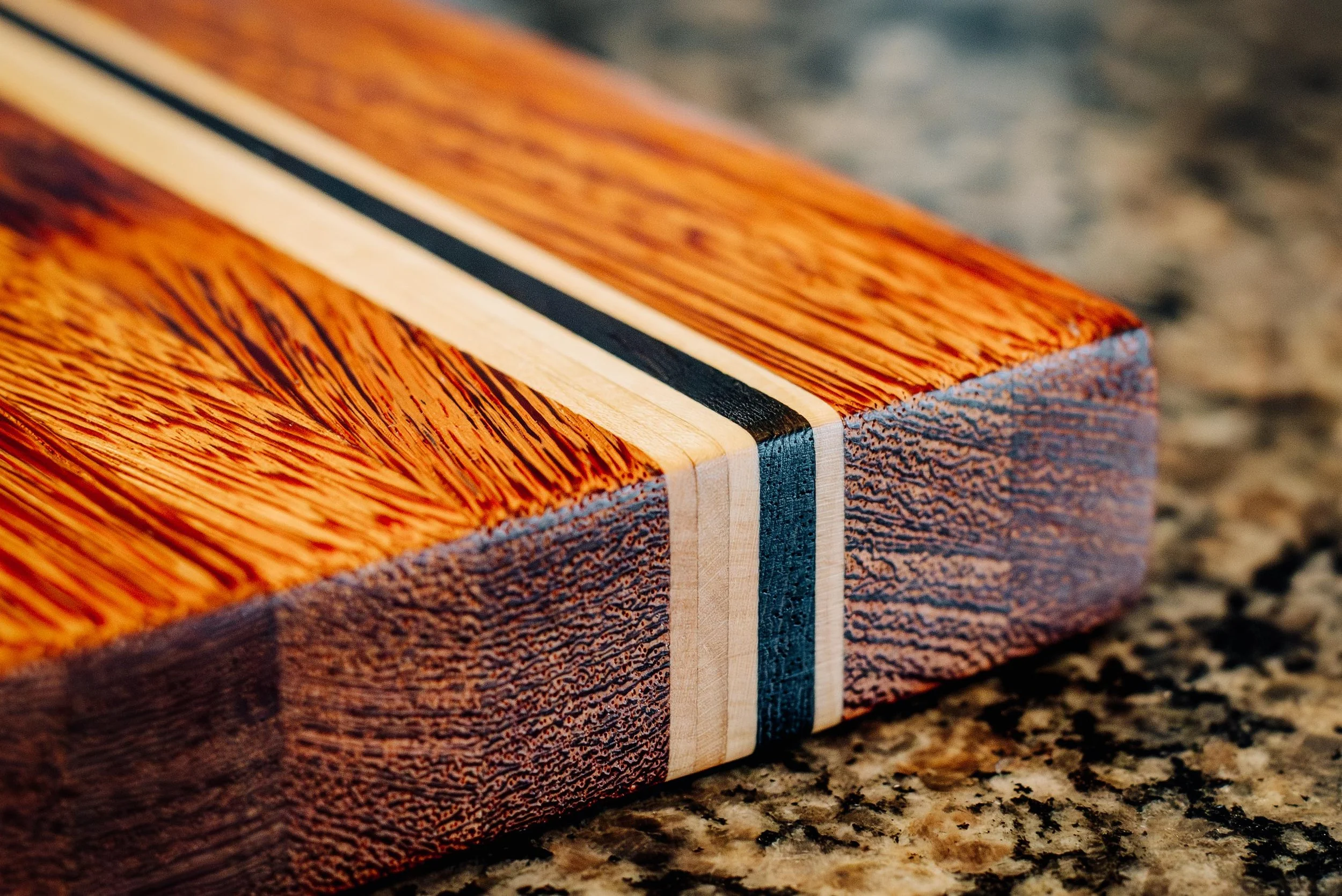
The cross-section. The cellular structure. The “tree rings.”
End grain boards require a bit more attention.
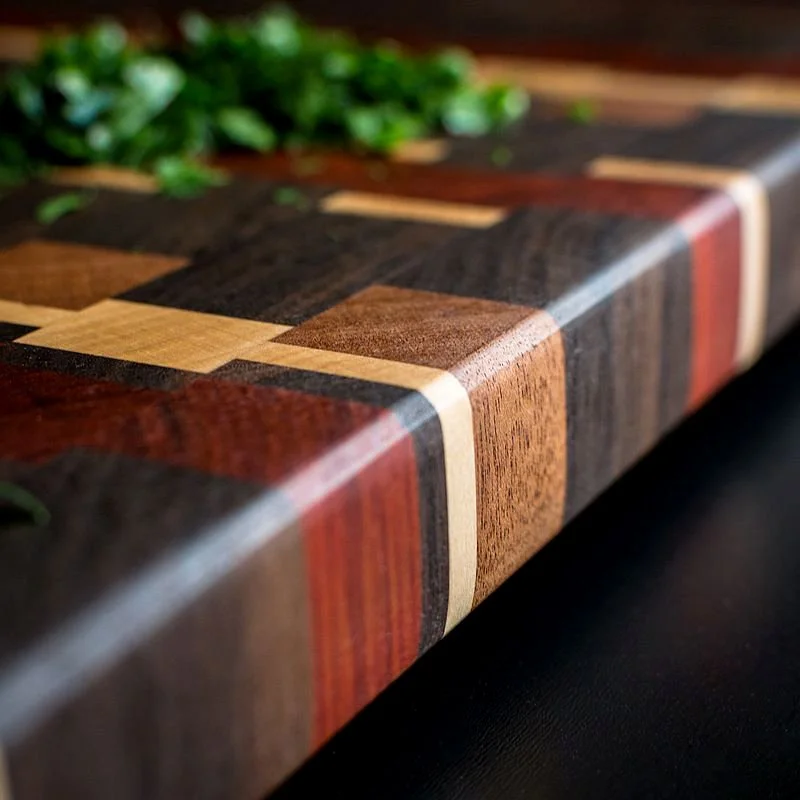
First, you rip your lumber into strips - those strips are glued into panels.
Then those panels are crosscut into blocks.
Then those blocks are rotated so the end grain faces up.
Then glued again.
Then flattened.
Then sanded.
Then sanded again.
And again, and again.
And then conditioned
You get the point.
In end grain boards, those structural fibers are now oriented vertically. When cut into with a knife, those fibers will open and then close back up. This almost creates something of a “self healing” surface to your cutting board.
Something to note here - wood moves across the grain. Not along it.
It’s physics. I don’t make the rules.
When we build glue-ups, we intentionally orient the grain to balance that movement. Moisture content + adhesive absorption is considered. Accuracy is measured obsessively. Clamping pressure is controlled.
Yah, sure…pretty is nice — but stable is sexy.
It’s engineering disguised as art.
Now here’s the part where we all the way down the rabbit hole:
There’s a persistent myth that plastic cutting boards are more sanitary than wood.
Spoiler alert: Research and decades of culinary practice say otherwise.
The simple truth of it is that plastic permanently scars. Once you get a good gouge in there, it is not going to come out and will continue to collect moisture and bacteria. Bacteria loooooves moisture. So, no.
Now don’t get me wrong…wood isn’t sterile. Nothing in your kitchen is. But high-quality hardwoods — especially tighter-grained species like oak and maple — exhibit natural antimicrobial tendencies because of its structure and chemistry. In addition to the moisture absorbing capillary action, some hardwoods even have antimicrobial tannins and phenols that have been shown to actively kill bacteria like E. coli and Salmonella.
In nature, hardwood tannins act as a defense mechanism against fungi, insects, and decay. Essentially, they penetrate the bacterial cell wall and suck up all it’s nutrients, leading to metabolic destruction and rapid cell death.
It’s all very fascinating and if you want to read some really nerdy shit about it, here you go: Science Direct
Hard maple (Acer saccharum)
remains the gold standard for cutting boards, not because it’s flashy (Yes, girl.. We know you’re beautiful), but because it’s functionally elite. Its extremely tight, closed grain structure limits deep bacterial penetration and resists excessive knife scarring. While maple isn’t particularly high in tannins compared to oak or walnut, its density and fine pore structure physically restrict microbial residency.
Black walnut (Juglans nigra)
brings a different layer of defense. It’s slightly softer than maple — which makes it gentler on knives — but still dense enough to prevent deep gouging. Its darker color doesn’t change sanitation, but it does visually mask staining while the natural phenolic compounds work quietly in the background.
Cherry (Prunus serotina)
offers a more moderate density and fine grain. It’s stable, food-safe when properly finished, and ages beautifully.
White oak (Quercus alba), though less common in cutting boards due to its pronounced grain, contains high levels of tannins and tyloses — cellular structures that block its pores — which make it more water-resistant and contribute to its natural decay resistance.
On the flip side - open-pored woods like red oak are less ideal for cutting boards because their larger vessels can retain more moisture.
And we don’t do softwoods.
Pine belongs in cabins. Not under your brisket.
The takeaway? Your cutting board is not a decorative afterthought. It’s a functional material system.
The right hardwoods — dense, tight-grained, and naturally rich in protective compounds — create a surface where bacteria don’t easily settle in or multiply. Add proper cleaning and routine oiling, and you’re not just maintaining wood. You’re maintaining performance.
And end grain? That’s physics. Thousands of vertical fibers that open under a blade and close back up again, minimizing damage and limiting microbial hangouts. It’s cellular architecture doing exactly what it was designed to do — just now in service of your sourdough era.
So the next time you pull out that 400-pound family heirloom — and marked by a thousand meals prepared for people you love — pause for a second.
Those marks aren’t damage. They’re proof. Proof of millions of years of evolution — nature’s architecture that, even after some great old tree has fallen, still holds memory in its grain. They’re Sunday family dinners, holiday chaos, and quiet mornings with coffee and a playlist that feels like home.
And yes… you’re also participating in some genuinely frickin’ cool applied material science.
Which is exactly the kind of main-character energy your kitchen — and your people — deserve.